
Material handling directly affects construction productivity. The wrong machinery can increase manual handling, slow material movement, and raise operating costs.
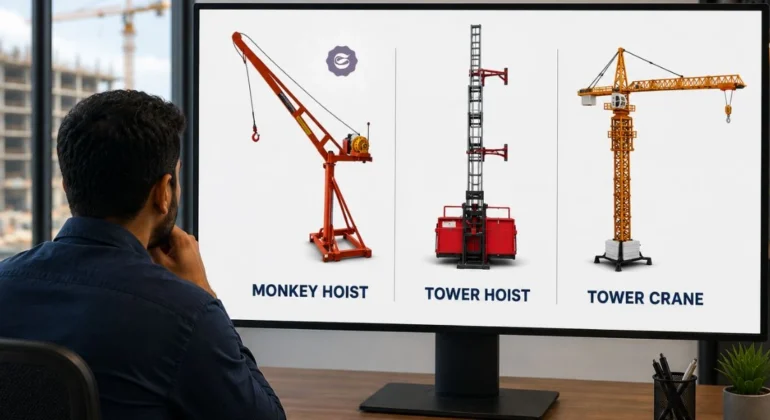
Construction sites use different lifting machines depending on project size, lifting requirements, material type, and movement pattern. A monkey hoist suits compact vertical lifting. A Multifunctional Tower Hoist for construction sites supports regular floor-to-floor material transportation, while a Passenger Material Hoist is designed for transporting personnel and materials between different levels, subject to its rated configuration.
A tower crane handles vertical and horizontal movement across a wider working area.The right choice depends on more than lifting capacity. Contractors need to evaluate lifting height, rated load, lifting frequency, site space, installation, power supply, material type, project duration, and the type of movement required.
Tower Hoist vs Monkey Hoist helps contractors select construction machinery based on the actual construction requirement.
Start With the Material Handling Requirement
Machinery selection starts with the lifting task.
First, identify the maximum load. Then determine the required lifting height and expected lifting frequency. Next, check the movement pattern. Some construction sites need only vertical transportation, while others require personnel and material transportation or vertical and horizontal movement across the site.
Before procurement, evaluate:
- Maximum rated load
- Required lifting height
- Lifting frequency
- Vertical or horizontal movement
- Personnel transportation requirement
- Installation space
- Electrical power
- Project duration
- Material type
- Structural support and anchoring
- Required safety and control systems
These factors create a clear equipment requirement before purchase.
When to Select Monkey Hoist?
A monkey hoist provides a compact solution for vertical material lifting on construction sites. It works well when the project needs a focused lifting point instead of a larger lifting system.
Typical applications include residential construction, low-rise buildings, renovation work, small commercial projects, and maintenance applications.
A monkey hoist can move suitable construction materials between ground and upper levels. The actual load and lifting height depend on the selected model.
Its compact arrangement can suit construction sites where a larger lifting system is unnecessary. However, contractors should not select it only because of its size. They should check rated capacity, lifting height, motor requirements, operating frequency, installation arrangement, structural support, and safety provisions.
When to Select a Multifunctional Tower Hoist?
A Multifunctional Material Hoist for construction sites is designed for repetitive vertical material transportation across multiple levels. It becomes useful when floor-to-floor material movement is a regular part of daily construction activity.
Typical applications include multi-story residential buildings, apartments, commercial buildings, extensions, infrastructure projects, and other construction sites requiring repeated vertical material handling.
A Multifunctional Tower Hoist can transport suitable construction materials such as bricks, blocks, formwork components, tools, equipment, and other compatible loads within its rated capacity. Depending on the model and configuration, multifunctional capabilities can support different material-handling requirements.
Its main advantage is dedicated vertical transportation. It can reduce repeated manual movement of materials between floors and support a more organized material-handling process.
This makes Tower Hoist vs Monkey Hoist an important decision when a project involves multiple levels, higher lifting frequency, or continuous material movement.
When to Consider a Passenger Material Hoist?
A Passenger Material Hoist becomes relevant when a construction project requires controlled transportation of both personnel and materials between different levels, according to the equipment’s rated design and applicable safety requirements.
PM Hoists are particularly useful for multi-story and high-rise construction sites where workers and construction materials need regular vertical access. They can support construction activities by reducing the time and effort involved in repeatedly moving personnel and materials through stairs or other manual routes.
Before selecting a PM Hoist, contractors should evaluate passenger capacity, material capacity, lifting height, cage configuration, lifting speed, frequency of operation, installation requirements, power supply, anchoring, safety systems, and applicable regulations.
A PM Hoist should not be selected simply because it offers higher capacity. The equipment must match the site’s personnel and material transportation requirements and should be operated according to manufacturer specifications and applicable safety standards.
When a Tower Crane Makes Sense
A tower crane provides a broader material handling solution. It lifts materials vertically and moves them horizontally through its jib and trolley system.
This makes it suitable for high-rise buildings, large commercial projects, infrastructure work, industrial construction, structural steel operations, and large formwork applications.
A tower crane can serve multiple lifting zones within its working radius. It provides greater flexibility when materials need to move between different areas.
However, this capability requires more planning. The project needs suitable space, foundation or anchoring arrangements, erection planning, operating controls, inspection procedures, and trained personnel.
A tower crane makes sense when the project genuinely needs its reach, lifting capability, and horizontal movement.
How to Choose Between Tower Hoist vs. Monkey Hoist?
The Tower Hoist vs Monkey Hoist decision mainly depends on project scale, lifting height, and frequency.
A monkey hoist suits compact and straightforward vertical lifting for suitable loads. A Multifunctional Tower Hoist suits construction sites where vertical material movement becomes a regular part of daily construction activity across multiple levels.
Consider lifting height first. Multiple working levels can create a stronger requirement for a dedicated tower hoist.
Then consider frequency. Occasional lifting may suit a compact machine. Continuous lifting creates a stronger case for a dedicated vertical transportation system.
Also compare rated load, material type, operating cycle, installation space, power requirements, and project duration.
The right Tower Hoist vs Monkey Hoist decision comes from the complete application, not just the initial purchase price.
How to Choose Between Tower Hoist vs Tower Crane?
The Tower Hoist vs Tower Crane decision mainly depends on the required movement.
A tower hoist primarily provides vertical transportation between defined levels. A tower crane provides vertical and horizontal movement across a wider working radius.
For example, a multi-story project may need regular movement of bricks, blocks, tools, and formwork between floors. A Multifunctional Tower Hoist can address this requirement.
A high-rise project may need to move structural components and other heavy loads between different site locations. A tower crane can provide greater reach and flexibility.
The larger machine is not automatically the better option. It should provide a clear project benefit.
How to Choose Between Monkey Hoist vs Tower Crane?
The Monkey Hoist vs Tower Crane comparison reflects a major difference in project scale.
A monkey hoist provides focused vertical lifting. A tower crane provides wider material handling coverage.
A small residential construction site may not need the working radius and installation requirements of a tower crane. A compact hoist can provide the required lifting function.
A large commercial or high-rise project may need the greater reach and lifting capability of a tower crane.
Project duration also matters. Smaller lifting requirements can favor compact equipment, while long-duration heavy lifting can justify a larger system.
Compare the Machinery Before Procurement
Table Summary: Monkey Hoist suits focused lifting, Tower Hoist suits floor-to-floor handling, PM Hoist suits personnel and material transport, and Tower Crane suits wide-area lifting.
A B2B buyer should compare the machines against practical construction site requirements.
| Factor | Monkey Hoist | Multifunctional Tower Hoist | PM Hoist | Tower Crane |
| Primary movement | Vertical | Vertical | Vertical | Vertical and horizontal |
| Typical use | Small construction sites | Multi-level construction sites | Personnel and material movement | Large and high-rise projects |
| Working area | Limited | Defined vertical route | Defined vertical route | Wide working radius |
| Personnel transportation | Generally not intended | Model-dependent | Designed for personnel/material use | Not its primary purpose |
| Horizontal movement | Limited | Limited | Limited | Yes |
| Installation | Lower complexity | Moderate | Higher | Higher |
| Best suited for | Focused material lifting | Repetitive floor-to-floor material lifting | Personnel and material transportation | Wide-area lifting |
Actual performance depends on the selected model, rated capacity, lifting height, configuration, and site conditions.
Check Capacity, Height and Duty Cycle
Rated load should remain one of the first specifications buyers check.
Start with the heaviest regular load. Do not select equipment based only on average material weight. The machine must operate within its rated capacity during every lifting cycle.
Lifting height also affects selection. Low-rise work may need a compact lifting arrangement. Multi-story construction requires equipment designed for the required height.
Lifting speed and duty cycle also influence productivity. Frequent operation increases the importance of motor performance, braking, controls, maintenance, and inspection.
This makes the Tower Hoist vs Monkey Hoist decision more than a simple capacity comparison.
Check Site Conditions and Safety
Site conditions can influence the final equipment choice.
Review installation area, loading points, structural support, anchoring requirements, electrical supply, working clearances, material storage, lifting zones, and access requirements.
Safety should form part of the selection process. Buyers should evaluate braking systems, emergency stops, limit controls, overload protection where applicable, control systems, wire rope arrangements, cage safety features for PM Hoists, and other manufacturer-specified safety features.
Operators need proper training. The equipment also needs regular inspection and maintenance.
Match the Machine to the Project
The Tower Hoist vs Monkey Hoist decision becomes easier when the application is clearly defined.
Choose a monkey hoist when the construction site needs compact vertical lifting for suitable loads.
Choose a Multifunctional Tower Hoist for construction sites when the project needs repeated floor-to-floor material transportation across multiple levels.
Choose a PM Hoist when the construction site requires regular vertical transportation of personnel and materials using equipment specifically designed for that purpose.
Choose a tower crane when the project needs heavy lifting combined with horizontal movement across a wider working radius.
Large construction projects can also use different lifting systems for different tasks. A tower crane can handle major structural lifting, while a Multifunctional Tower Hoist or PM Hoist can support regular vertical transportation.
Get the Right Material Handling Solution for Your Site
Need help choosing between a tower hoist, monkey hoist, or PM Hoist for your construction project? Smiit Constech provides construction machinery solutions for demanding construction site applications.
Share your required load capacity, lifting height, project type, material, personnel transportation requirement, and lifting frequency to identify the right equipment for your application.